Your cards. Your book. One step at a time.
Cards out.
Start here.
Choose a reading below and follow it from start to finish. This guide shows you what to do; the companion book helps you discover what your cards mean.
Stage 1: read the cards. Lay them out, then combine each card’s meaning with its place in the spread.
Stage 2: read the connections. Look at the two symbols facing each other where cards touch. See the illustrated symbol lesson →
Keep your physical deck and companion book beside you. References below use the printed page numbers in the supplied 2025 manual. In that edition’s PDF viewer, add 18: book p. 275 is PDF page 293.
One card · The One
One question.
One place to begin.
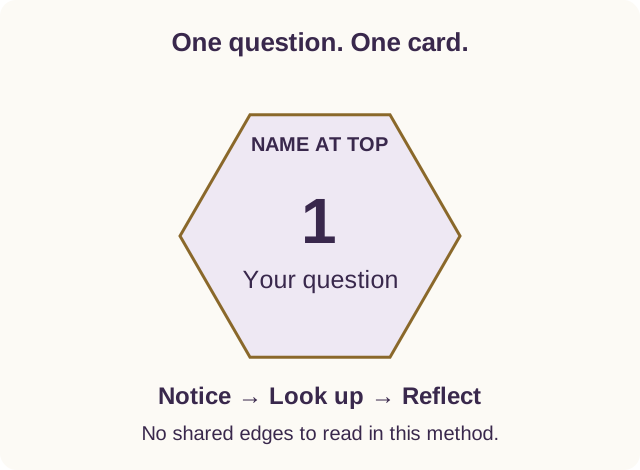
Start here if you want to get familiar with the cards. There are no positions or shared borders to compare.
Pause and choose a question
Lay all 64 cards face down in a circle, leaving part of every card’s back visible. Hold one question in mind, such as “What would help me understand this situation?”
Draw one card
Place it face down in front of you. Turn it face up, with its name at the top. Creatrix cards are read upright, not with reversed meanings.
Look, then read
Notice the image, card name and archetype. Find its short meaning in the Snapshot, pp. 310–315, then read that card’s Overview for depth.
Bring it back to your question
Ask “What does this meaning help me notice?” Write one observation or a small action you could take. A single card has no shared-edge connection; you can finish here.
Example: Dolphin · Insight
Question: “What could help me approach a difficult conversation?” Dolphin’s Overview explores trust, communication and empathic listening. A useful reflection might be: “I could listen before defending my point of view.”
Dolphin: pp. 206–209; Overview pp. 207–208. One-card method: p. 275.
Three cards · The Divine Trinity
The situation.
The path. The outcome.
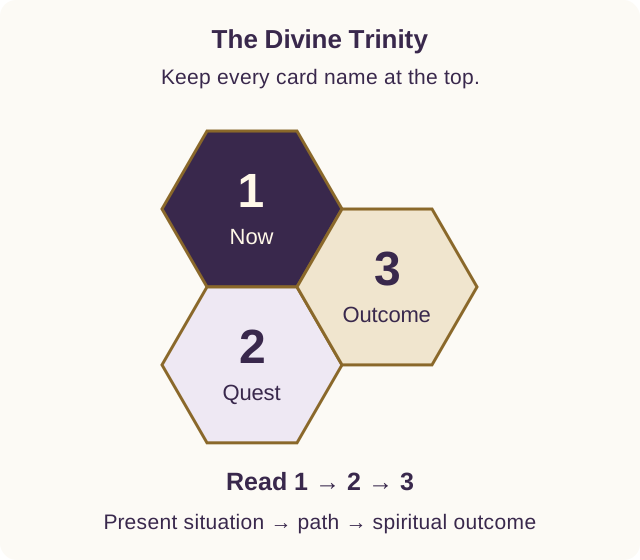
This is the book’s triangular three-card method. Read it as current circumstance → hopes and dreams → spiritual outcome, rather than a past/present/future spread.
Prepare your question
Lay the 64 cards face down in a circle, with part of each back showing. Pause and hold one question in mind.
Draw into the triangle
Draw card 1 and place it face down at the upper left. Put card 2 directly below it. Repeat your question and draw card 3, placing it to their right as shown. Bring the adjacent edges together.
Turn over and read 1 → 2 → 3
Keep each name at the top. Use the position questions below, alongside each card’s Snapshot meaning and Overview. Read the card in its position before moving on.
Join the three ideas
Finish this sentence: “My situation is asking me to notice …; the path may involve …; the outcome invites …”. Then explore the three shared edges using the symbol lesson below.
- 1 · Current circumstance
- Material Plane. What do I need to understand about the situation now, before moving forward?
- 2 · The quest
- Ethereal Realm. What could help me move towards my hopes and dreams?
- 3 · Spiritual outcome
- What could support the desired outcome?
Example: a difficult conversation
1 Dolphin / Insight: notice how you communicate. 2 Saturn / Meditation: pause and learn from experience. 3 Octopus / Acceptance: be flexible and attend to manageable details.
Together: “Better listening is the starting point. A thoughtful pause could help me respond differently. I can work towards acceptance without forcing everything to go my way.”
Method: p. 276. Example cards: Dolphin pp. 206–209; Saturn pp. 112–115; Octopus pp. 194–197. The triangle creates one I Ching pairing and two Tarot/Astrology combinations.
The book also has a different three-card Divine I Ching layout on pp. 276–277. The triangle shown here is the Divine Trinity; keep to this layout for this walkthrough.
↑ Choose another readingSeven cards · HEART ID / The Divine Wheel
Start at the heart.
Follow the whole story.
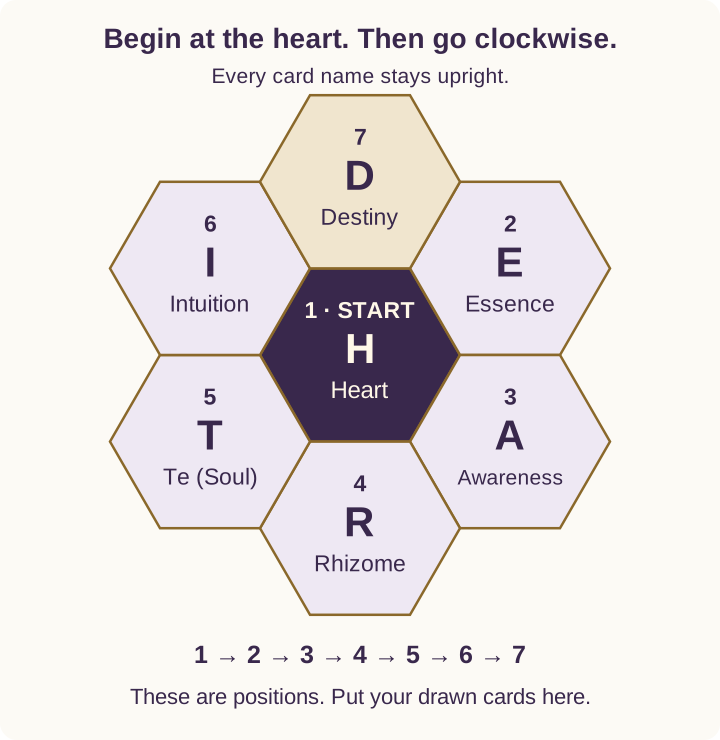
One card sits in the centre and six surround it. Each place asks a different question. HEART ID helps you remember those seven questions.
Settle on your question
Lay all 64 cards face down in a circle. Take a moment to focus on the matter you want to explore.
Draw and build the wheel
Use your non-dominant hand. Place card 1 face down in the centre. Place card 2 at the upper right, then continue clockwise through positions 3 to 7. Adjacent edges touch.
Turn over and follow HEART ID
Keep every name at the top. Read the centre card, then positions 2–7. For each one, combine the position’s question + the card’s meaning + your own question. Use the plain-English key below.
Gather the story, then the connections
Read your seven reflections together. What theme repeats? What changes from Heart to Destiny? Next, work through the touching symbols one join at a time. The full wheel has 12 joins; you do not need to understand them all at once.
HEART ID, in everyday language
- 1 · H · Heart (Core)
- The heart of the issue. What does the situation need me to hear here and now?
- 2 · E · Essence (Ego)
- Energy and choice. What habit or personality trait could I release—or bring into my response?
- 3 · A · Awareness (Consciousness)
- What to notice consciously. What should I consider before moving forward?
- 4 · R · Rhizome (Root)
- Roots and foundation. What lesson from the past can support me now?
- 5 · T · Te (Soul)
- Harmony. What could I release or integrate to bring the situation into better balance?
- 6 · I · Intuition (Id)
- Instinct and the subconscious. What inner impulse or less-conscious response deserves attention?
- 7 · D · Destiny (Super Ego)
- Direction and outcome. What does this final card suggest about the outcome? Connect it back to Heart.
Why “Essence” and “Intuition”? Those are the book’s position labels. Its explanation also calls Essence “Energy”. Identity means I + D together, not the I position on its own.
Example: Saturn in I · Intuition
Your question is “What could help me approach a difficult conversation?” The position asks you to notice an instinctive response. Saturn / Meditation adds a pause for reflection.
Put them together: “What might I notice about my first reaction if I pause before speaking?” Your answer might be “I rush to defend myself; I could listen first.” This is how the same card takes on a specific role in a spread.
HEART ID: pp. 278–279. Saturn: pp. 112–115. The full wheel has four I Ching pairings and eight other Tarot/Astrology combinations.
Stage 2 · The connections
Two cards touch.
Two symbols meet.
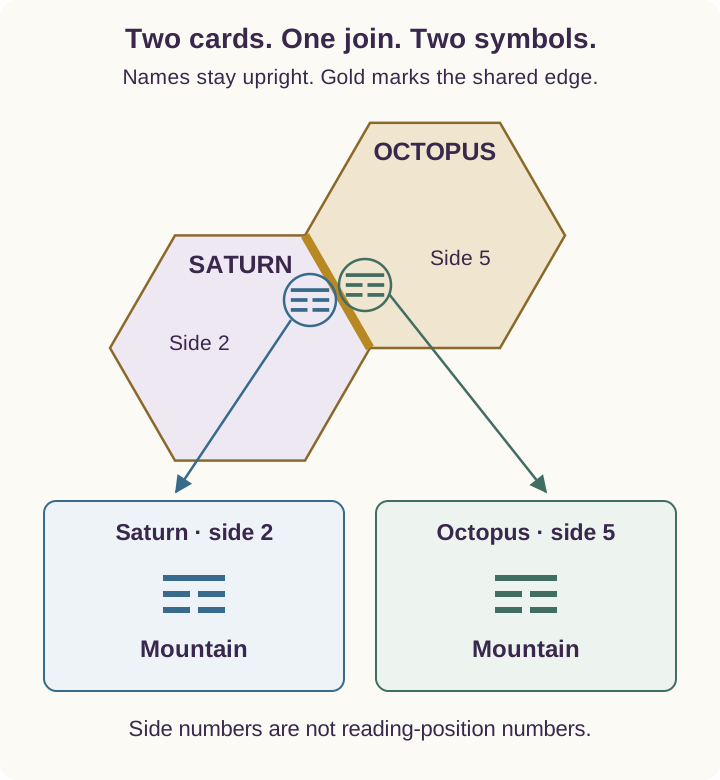
A “touchpoint” simply means the shared edge between two cards. Look at the little symbol on each side of that join: one belongs to each card. Read those two influences together to add detail to the main reading.
Every card has two Tarot, two Astrology and two I Ching influences. The symbols do not have to match. Keep the cards upright in their original places; don’t turn them around to make a match.
Choose one shared edge
Read the main cards first. Then choose one place where two of your cards touch. Find the two small symbols facing each other across that edge.
Identify both symbols
Use the Great Table, pp. 298–299, to check the six influences on each card. Tarot symbols are explained on pp. 283–284; Astrology on pp. 287–288.
Take the right route
Tarot/Astrology: read both influences in the relevant card entries, then relate them to the positions and your question. I Ching/I Ching: combine them using the chart, as shown next.
Add one sentence
Ask “What does this connection add to the story?” Write a short reflection. Then look at the next shared edge if you want to go deeper.
Two different kinds of number: a reading position tells you a card’s role in the spread. A side number tells you where to look around one card. Side 2 does not mean the second card you drew.
Worked I Ching connection: Mountain + Mountain
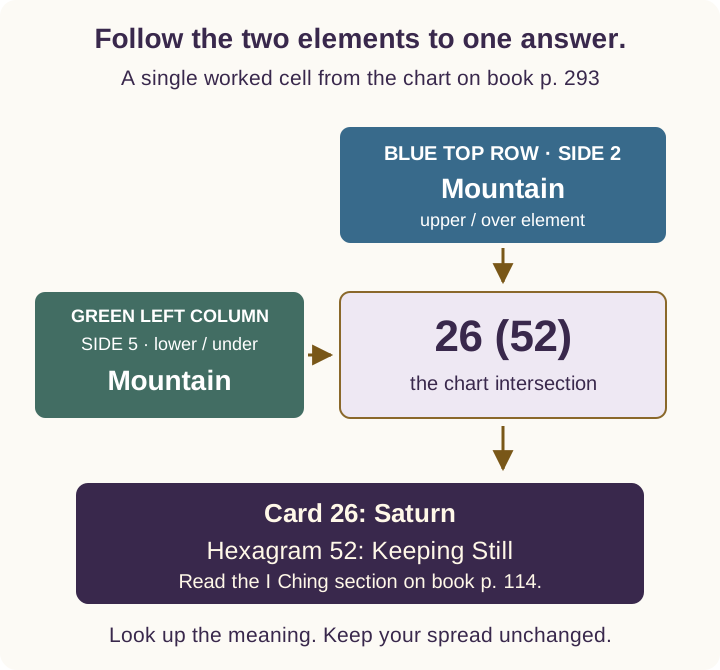
1. Identify: Saturn’s side 2 is Mountain. Octopus’s side 5 is also Mountain. Check pp. 298–299.
2. Look up: on the I Ching chart, p. 293, side 2 supplies the upper/over element in the blue top row. Side 5 supplies the lower/under element in the green left column. Follow the row and column to their meeting point.
3. Read the result: Mountain + Mountain gives 26 (52). The 26 sends you to Creatrix card 26, Saturn; 52 is the I Ching hexagram Keeping Still. Read its explanation on p. 114.
4. Apply it: the meaning explores knowing when to pause and when to move. For our conversation example: “What might I hear if I pause before reacting?”
26 (52) is a lookup result. It does not mean page 26 or “draw another card”. Leave your spread as it is. “Upper” and “lower” are the chart roles of sides 2 and 5—not whichever card happens to sit higher on the table. See the instructions on p. 294.
A Tarot + Astrology connection
In our three-card example, Dolphin’s bottom edge (side 4), Four of Swords, touches Saturn’s top edge (side 1), Saturn.
Dolphin’s Tarot explanation links Four of Swords with meditation, negotiation and resolving disagreement (p. 208). Saturn’s Astrology explanation brings discipline, experience and practicality (p. 115).
Together: “A calm, practical conversation could help me use what I’ve learned instead of repeating an old argument.”
Keep the companion book close
Where to look next.
- Card orientation and structure
- pp. 5–8
- One card / Divine Trinity / HEART ID
- p. 275 / p. 276 / pp. 278–279
- Fast card meanings · Creatrix Snapshot
- pp. 310–315
- Tarot symbols / Astrology symbols
- pp. 283–284 / pp. 287–288
- I Ching chart and instructions
- pp. 293–294
- All six influences for every card · Great Table
- pp. 298–299
The book also teaches the Divine I Ching three-card method and the four-card Perfect Square on pp. 276–277. This quick guide focuses on the three methods above.
Your reading in six words:
Choose → Place → Reveal → Read → Connect → Reflect.
Finish with one useful observation or action you want to carry into your day.